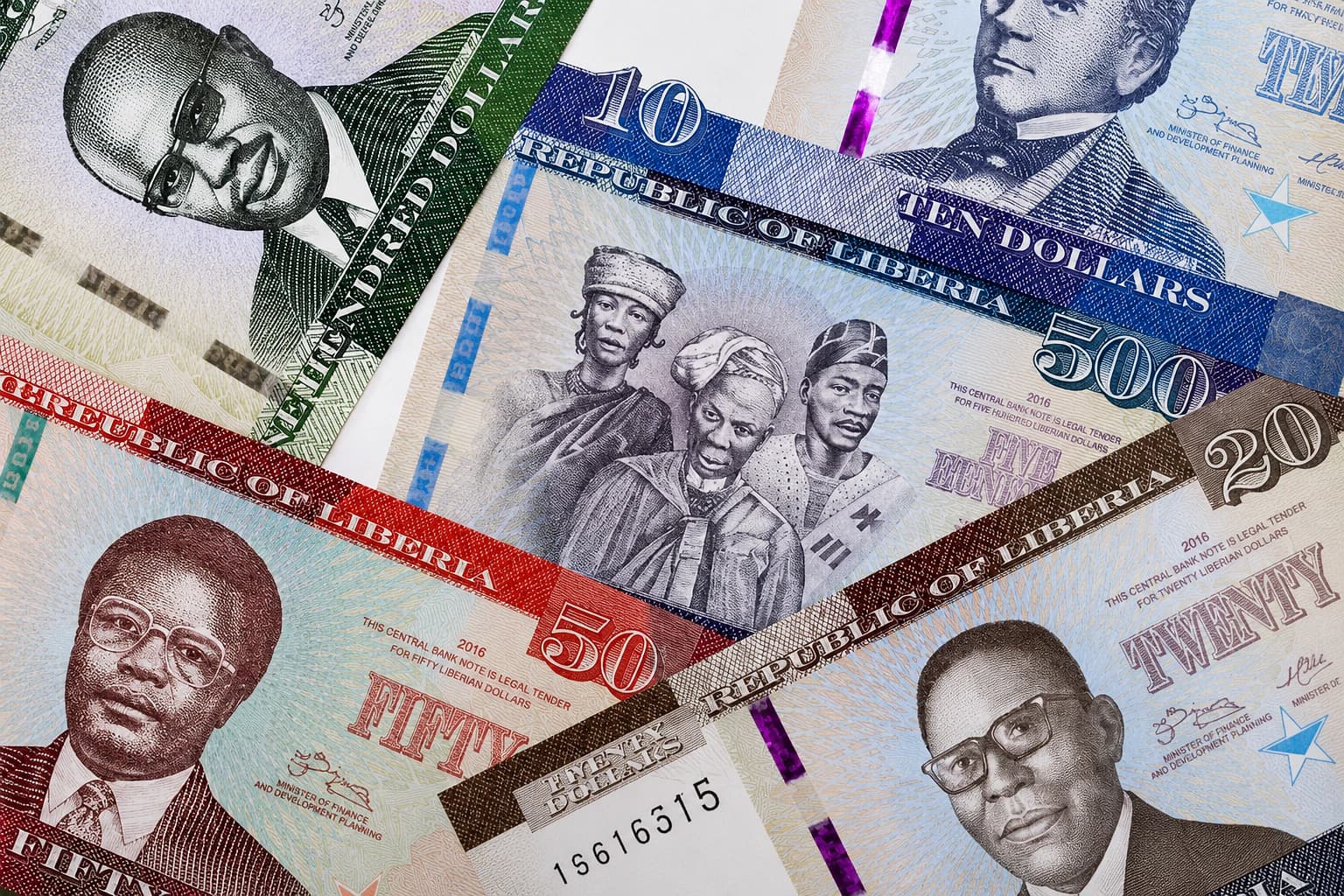

The Liberian dollar closed March 2026 at L$183.93 to the US dollar, about 8 percent stronger than a year earlier but weaker than at the end of 2025, according to exchange-rate data published by the Central Bank of Liberia (CBL).
The rate is among the most consequential numbers in the Liberian economy. Liberia operates a dual-currency system in which the Liberian and US dollar circulate side by side, and it imports most of what it consumes. A stronger Liberian dollar lowers the local-currency cost of imported fuel, food and equipment, easing one of the main channels through which prices rise; a weaker one does the opposite.
On the CBL's end-of-period measure, the US dollar bought L$183.93 in March, up only fractionally from L$183.51 in February — a rise of 0.2 percent, meaning the Liberian dollar was essentially flat on the month. Against March 2025, when the rate stood at L$199.76, the local currency has appreciated about 8 percent.
The gain over the year masks a softer start to 2026. The Liberian dollar ended December 2025 at L$178.66 per US dollar, its strongest level in recent months. It then weakened to L$186.18 in January before recovering part of the move in February and March — a net give-back of roughly 3 percent from the December peak.
The CBL's period-average measure tells the same story: the dollar averaged L$183.44 in March 2026 against L$199.22 a year earlier, a fall of about 8 percent in the local currency's terms over twelve months.
The currency operates as a managed float, with the CBL intervening in the interbank market to smooth volatility rather than defending a fixed peg. By historical standards, the present level sits toward the stronger end of the 2026 trading band of roughly L$177 to L$187, and well clear of the all-time low near L$210.81 reached in October 2019.
Several forces have underpinned the relative stability. Export earnings have surged — gold export receipts more than doubled over the year and overtook iron ore as the country's top earner — and inward transfers, largely remittances, ran above US$940 million in 2025. Foreign reserves stood near US$576 million at the end of 2025, about two months of import cover, according to World Bank data, giving the CBL a modest buffer to lean against sharp moves.
The risks run in one direction. A reversal in iron-ore or gold prices, or a softening in remittances, would cut the foreign-exchange inflows that have supported the currency, and the reserve cushion remains thin by international standards.
What to watch in the months ahead is whether the early-2026 softening extends into the second quarter, and how the exchange rate feeds through to imported prices and inflation.