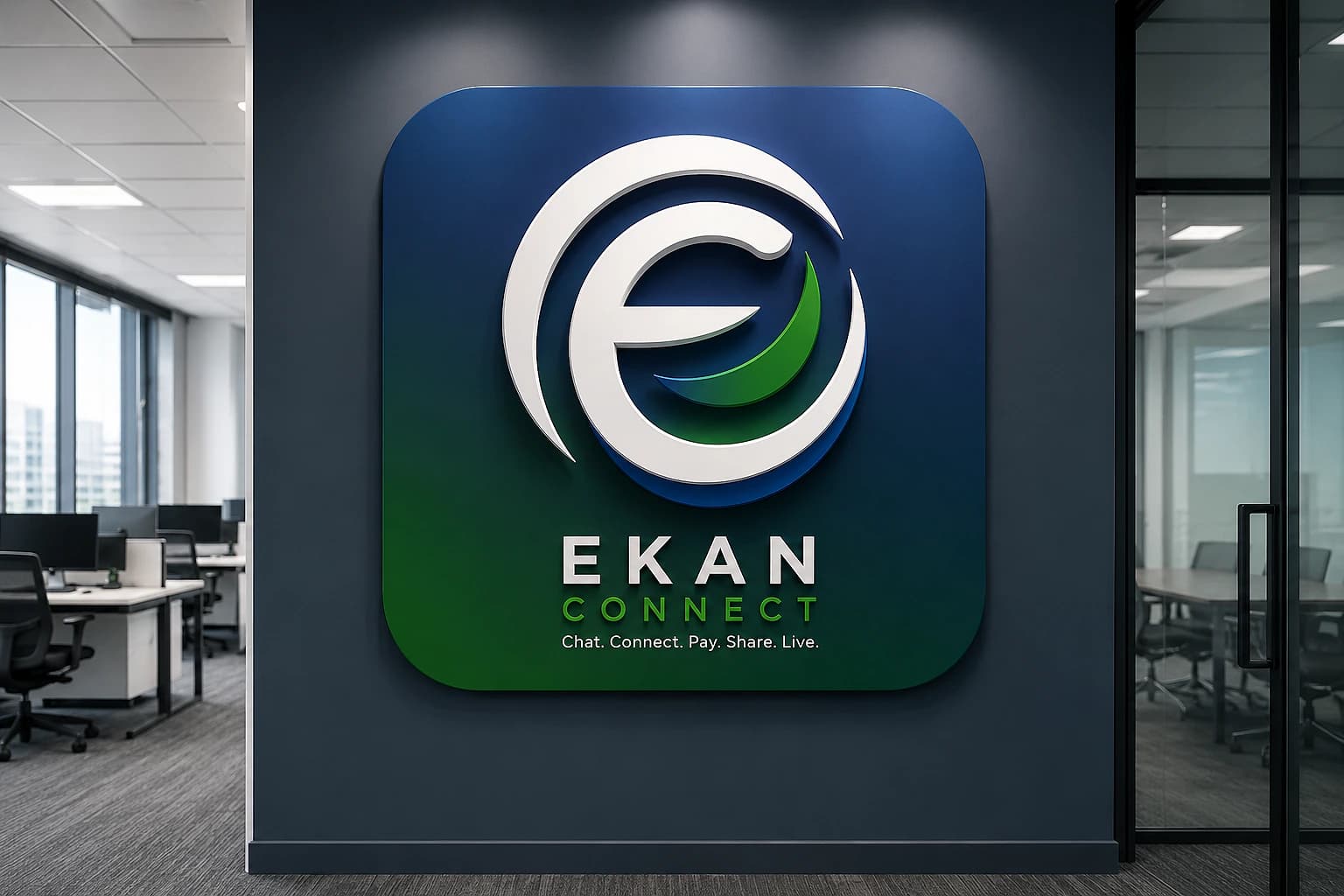
EKAN International, a startup co-founded by Alfred M. Nyeswa and Emric N. Kikeh, is developing a product called EKAN Connect that merges instant messaging with financial transactions — peer-to-peer payments, micro-invoicing and escrow settlement, all inside end-to-end encrypted conversations.
The pitch is simple and, by global fintech standards, familiar: commerce happens where conversations happen, so put the payment rail inside the chat. What makes it worth watching is the market it is aimed at. In West Africa, where mobile money already moves more value than traditional banking channels in several countries and where smartphone messaging is the default business communication tool, the gap between the conversation and the transaction is a real source of friction — not an abstraction.
EKAN Connect is built around three pillars. The first is a messaging interface with what the company calls contextual actions — triggers that let a user request or send funds directly inside a chat bubble without leaving the conversation. The second is an integrated payment gateway branded Message-Pay, which handles peer-to-peer transfers and lets businesses generate, dispatch and track invoices natively within client threads. The third is enterprise-grade security: end-to-end encryption for all messages and tokenized handling of financial data, so that card numbers and account details never surface in the chat interface.
The target users are the people for whom the existing payment infrastructure is either too cumbersome or too disconnected from their workflow. Micro-merchants selling through WhatsApp or Facebook Marketplace who currently screenshot invoices and share account numbers over unsecured chat. Freelancers and gig workers who toggle between a messaging app and a mobile-money interface to confirm deliverables and collect payment. Families splitting bills or sending allowances across borders. In each case, the transaction today requires leaving one app, opening another, entering details manually, and returning to confirm — a process that produces drop-off, errors and, in some cases, fraud.
The competitive landscape is crowded but fragmented. Mobile-money giants like M-Pesa and Orange Money dominate transfer volumes across the continent but operate as standalone platforms, not conversational interfaces. WhatsApp has rolled out in-chat payments in select markets, but its coverage in West Africa remains limited and its merchant tools are basic. Dedicated fintech apps like Flutterwave and Paystack handle business payments elegantly but do not embed into messaging. EKAN Connect is betting that none of these players has combined the messaging layer and the payment layer into a single, encryption-first product designed for the informal and semi-formal commerce that dominates West African economies.
The bet is not without risk. Payments are a regulated business, and EKAN International has flagged regulatory compliance — securing local and regional fintech and money-transmitter licenses — as an immediate priority. Licensing requirements vary by country across ECOWAS, and navigating them is expensive and slow. The Central Bank of Liberia, like its regional peers, has been tightening oversight of digital financial services, raising both the cost of entry and the cost of getting it wrong.
There is also the trust problem. Embedding payments into a messaging app means persuading users to store value and execute transactions inside a platform they associate with conversation, not banking. Mobile money succeeded in part because telecom operators already had distribution networks — agent kiosks in every market — and brand recognition. A startup without that physical footprint has to earn trust digitally, which in a market where fraud concerns are high is a slower process.
EKAN International's near-term roadmap includes API expansion — building open plugins so third-party e-commerce tools can embed EKAN Connect directly into existing merchant workflows — and AI-powered ledger reconciliation to help business users track revenues automatically inside the chat interface. The company is also exploring cross-border settlement, which would position the platform not just as a domestic tool but as a corridor for the remittance and trade flows that link West African economies.
Whether EKAN Connect can execute on this vision depends on questions that no about document can answer: Can it secure the licenses? Can it acquire users in a market where switching costs are low and network effects are everything? Can it build the agent or merchant network that gives the platform utility on day one? These are the same questions every fintech startup in Africa faces, and the failure rate is high.
What makes the concept worth tracking is the structural opportunity. Africa's digital payments market is projected to exceed US$40 billion in transaction value by 2028, according to multiple industry estimates, driven by smartphone penetration, urbanization and a young population that defaults to mobile-first interactions. The share of that value that moves through conversational interfaces — rather than standalone apps — is still small. EKAN Connect is positioning itself at the intersection of those two trends, and in a region where the infrastructure is still being built, the companies that get the interface right may end up defining the category.