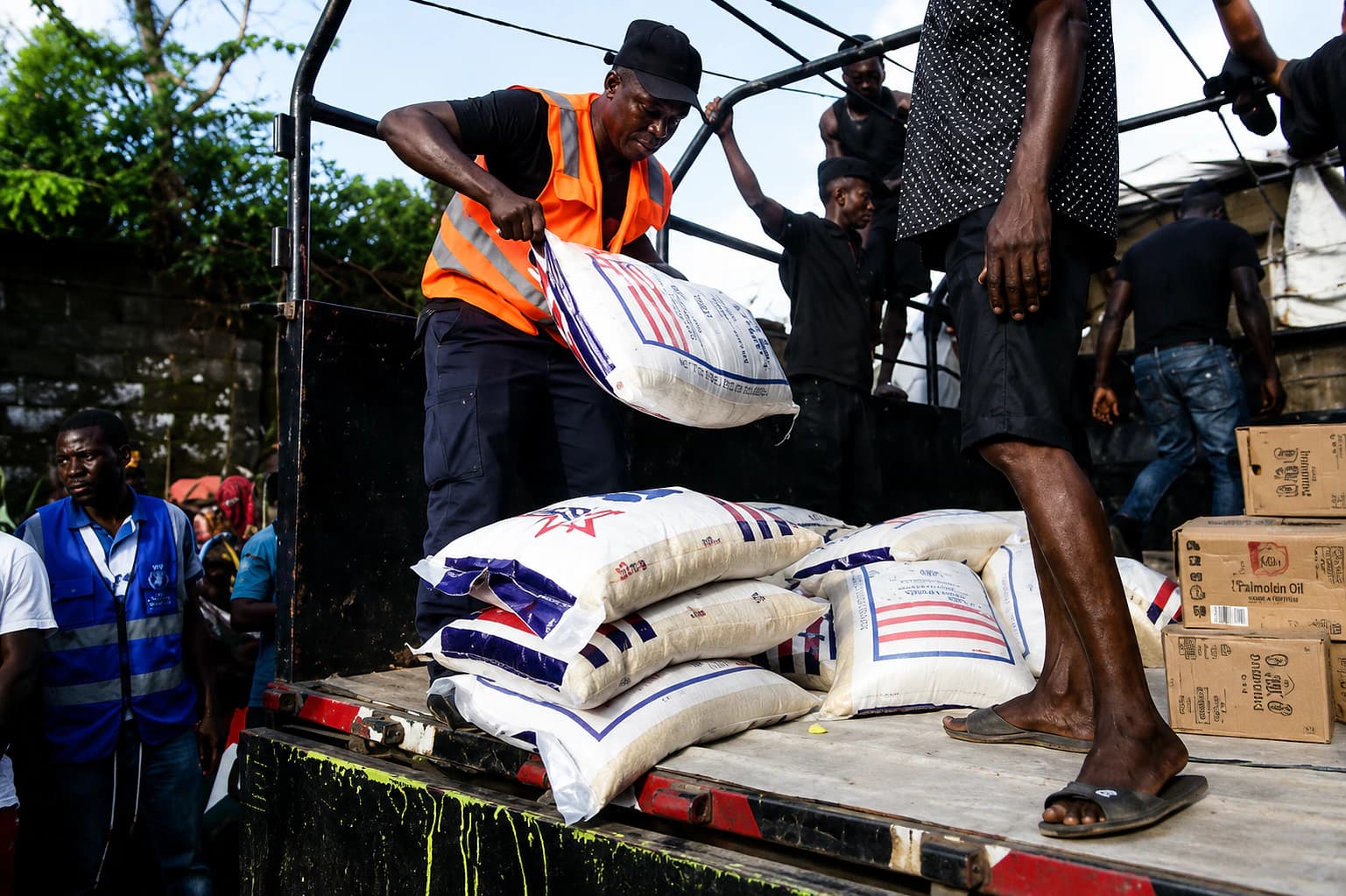
No commodity carries more political weight in Liberia than rice, the staple at the center of household diets and, historically, of unrest. Rice output was valued at about US$295.8 million in 2025, down about 15.6% from US$350.5 million a year earlier, according to the Liberia Institute of Statistics and Geo-Information Services (LISGIS) via the Central Bank of Liberia.
The decline in domestic rice value follows a stronger 2023 and 2024, and it lands in a country that does not grow enough rice to feed itself. Liberia imports a large share of its rice, which means the price on the market is set as much by world prices, shipping and the exchange rate as by the local harvest.
That import dependence makes rice a perennial flashpoint. Sharp increases in the price of imported rice have triggered protest in Liberia's past, and governments treat the stability of rice supply and price as a matter of political as well as economic management. A weaker harvest that deepens reliance on imports raises that sensitivity.
Lifting domestic rice production has been a development goal for decades, pursued through seed and input programs, mechanization and irrigation schemes. Progress has been slow against constraints familiar across Liberian agriculture: smallholders with little access to credit and inputs, poor roads that raise the cost of getting rice to market, and minimal local milling and storage.
The stakes go beyond economics. Rice self-sufficiency would cut the import bill, save foreign exchange, insulate households from world price swings and strengthen food security in a country where many live close to the margin. Each year of weak domestic output postpones that goal.
Domestic rice value has swung over recent years — from US$309 million in 2023 to US$350 million in 2024 and back to US$296 million in 2025 — reflecting the volatility of harvests dependent on weather and inputs.
The politics are not hypothetical. A sharp rise in the price of imported rice helped trigger deadly riots in 1979 that preceded a coup, and every government since has treated rice supply and price as a question of stability as much as economics. That history is why a weak domestic harvest, deepening reliance on imports, draws attention beyond the agriculture ministry.
What to watch is whether investment lifts domestic rice output, how world prices and the exchange rate move the cost of imports, and whether food security improves across all counties.